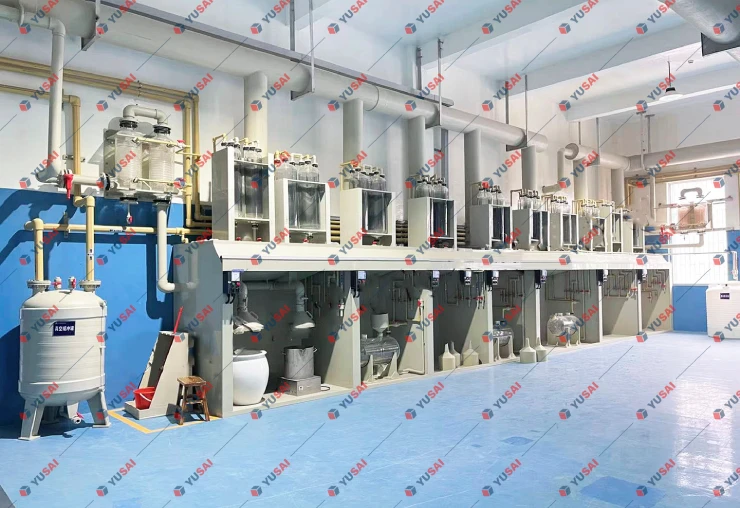
Repeated Ammonium Chloride Precipitation Method
- Solution Adjustment: The platinum concentration in the solution is adjusted to Pt50-80g/L. While stirring, NH₄Cl is added to the heated solution to form yellow (NH4)2PtCl6 precipitate:
H2PtCl6+2NH4Cl=(NH4)2PtCl↓+2HCI
Excess NH₄Cl is added to maintain a free NH₄Cl concentration of 5–10% in the solution. After cooling, the ammonium chloroplatinate salt is filtered out, leaving soluble chloride salts of base metals and low-valence chloroammonium salts of gold, palladium, and iridium in the solution. - Washing and Purity Check: The platinum ammonium salt is washed with a 5% NH4Cl solution (acidified with HCl to pH = 1). A small sample is calcined to spongy platinum for spectral analysis. If purity is insufficient, the entire batch can be recycled as crude platinum for re-dissolution, or alternatively, the following simplified method can be applied:
√ After filtering out minor insolubles, hydrazine hydrate is used to reduce platinum black from the solution at room temperature.
√ The platinum black is then dissolved using HCl + H₂O₂, followed by re-precipitation as pure platinum ammonium salt with NH₄Cl. - Final Refining: For crude platinum with an initial grade of 90%, three cycles of dissolution → ammonium chloride precipitation typically yield pure (NH4)2PtCI6. Calcination at 800°C produces spongy platinum with a purity of 99.99%.